Showing posts with label NYS Teaching Standards. Show all posts

Sunday, November 21, 2010

DOMAIN 1: INTASC Standards #2 & #5

Domain I
Motivation, Learning, and Development
Overview

Standard #2:  The teacher understands how children/adolescents learn and develop, and can provide learning opportunities that support their intellectual, social, and personal development.

Standard # 5:  The teacher uses an understanding of individual and group motivation and behavior to create a learning environment that encourages positive social interaction, active engagement in learning, and self-motivation.


A teacher’s approach to each group of students is going to vary from group to group depending upon the students’ levels of development and motivation for learning. Assessing the intellectual and social development of each student as an individual and the group as a whole is going to determine how the teacher will structure the classroom and instruction to provide students with the motivation and guidance to further develop intellectually, socially and personally.


Standard #2 Artifact:  Melody, the beginning of composition


Artifact Rationale

    Creating and sharing music through both written and notation and performances provide a well-rounded approach to the learning and development of music skills. As an introduction to learning what key a piece is in students were given a composition exercise to complete out of the Standard of Excellence band method book by Bruce Pearson. Students were given an exercise with blank beats and were given the freedom to choose any pitch they would like to complete the piece. The only criteria the students had to fulfill were A) to use the specific rhythms supplied for them B) only use notes that you know how to play and C) be able to perform your composition in class. Upon returning to class the students participated on many different levels. They assumed the responsibility for their work by performing it for the class. Then while their peers were performing they listened and responded constructively to their peers’ compositions. After everyone in the group lesson had performed the class participated in a group discussion about the endings of each different composition. This conversation opened the door for the next lesson on keys. I have found that creating a positive environment students have the confidence to take risks. Once a comfortable environment has been created I will continue to provide students with weekly solo opportunities to continue their personal development.
    This artifact is an appropriate example of INTASC standard # 2 because the teacher provides and activity that allows him/her to access the students’ musical and intellectual thinking through performance and discussion.


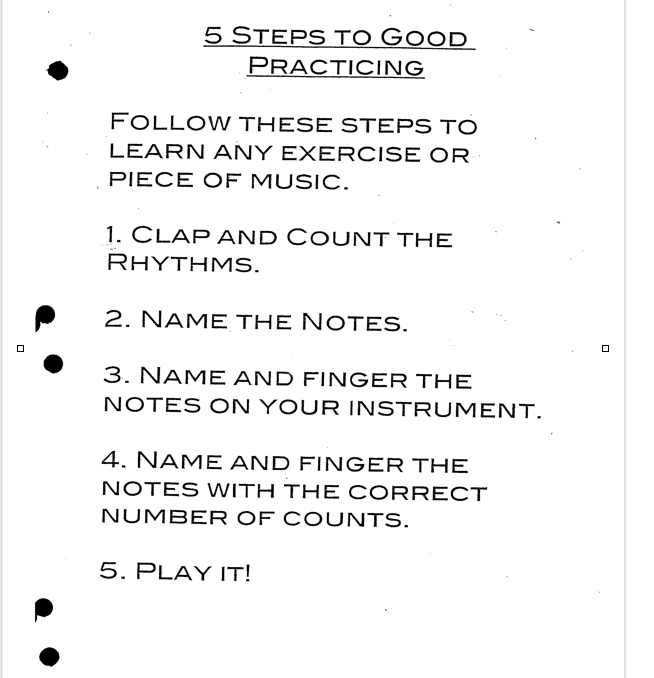
Standard #5Artifact: 5 Steps to Good Practicing

Artifact Rationale

    As teachers we need to help students become diverse learners in that they can progress as individual learners as well as work cooperatively with others. Practicing is typically thought of as a process of learning alone but it can be done in a group by using a set of guidelines called the “5 Steps to Good Practicing.” During class the students participate on varying levels. Given the “Mexican Hat Dance” out of the “Standard of excellence” band method book by Bruce Pearson the students clapped and counted the rhythms out loud together. Next, for step two the students took turns going around the room naming one note at a time in succession. The students then performed the last three steps together. Once the five steps were completed students had the readiness to perform the “Mexican Hat Dance” as a solo and eagerly volunteered to do so. I found that varying students’ level of participation keeps them actively engaged in the lesson, not knowing what type of participation or when they will having to respond individually keeps them on task.
    This artifact is an appropriate example of INTASC standard # 5 because the teacher encourages the students to develop a sense of value for the knowledge that their peers share have by creating a situation in which the students are dependent upon the information to have a complete learning experience. 

Sunday, November 7, 2010

Teaching Standards

Seaford HS Music Dept
This past spring I student taught in the Seaford Union Free School District on Long Island. Through the struggles, triumphs and laughter I learned a LOT! This week I am going to be posting the first part of my "Professional Teaching Portfolio"


A teaching portfolio from a CW Post graduate is a map of the students life over the course of a four month period. Sweat, lots of tears, love and hate go into putting together these portfolios because they will follow them for the rest of their teaching career.


Here is the beginning of the "meat & potatoes" of my portfolio; the fluff and filler (rep. lits, concert programs, etc...) will not be posted in their entirety, but enough to show an economic format. All of the lesson plans and Standard examples were successfully created, edited and executed by me with the feedback from cooperating teachers in the Seaford School District and superviors from the CW Post Music Department.


“Philosophy of Music Education”

       The education of our students is of fundamental importance. Music is a medium that offers a variety of areas to study that educates students wholistically. Music education is A) entertaining, B) educates our students mentally, physically and C) expands intrapersonal relationships.
       Music has always been a fun thing to break up long day. Music may not feel like work and hard concentration during grammar school and that’s the point! The most natural progression of learning, such as the Gordon Learning Theory, helps the students to discover a body of musical knowledge with the guidance of a teacher. This theory lends itself to all types of learners and has proved itself very flexible in being paired with other music learning tools such as the Kodaly’s solfege syllables and the Curwen hand signs. Kids need to acquire knowledge and social skills but they should not be boring. Through my student teaching experiences at the elementary level, I have found that by using Dalcroze’s philosophy of learning through kinestetic exercises such as rhythm clapping, and other multi-sensory methods of presentation helps to reach every child. They are more receptive to the material being taught and are more apt to share their musical experiences with others.
       Logical and mathematical skills are positively impacted as a result of learning the organization needed for performing. A substantial amount of music reading is mathematical; rhythms are counted and are proportionate to the meter being studied. Linguistic skills advance as well due to the vocabulary and communication required to discuss music history, playing techniques and music reading itself. Communication is expanded from peer to peer, and student to teacher.   
       While studying music students are working their bodies. Before one even picks up an instrument one is using his or her hands to put rhythms in their bodies. Clapping or patting the rhythms on ones legs aides in the development of some hand-eye coordination as well as helping to internalizing rhythms. Lung capacity is built up slowly over time due to the gradual increasing of practice and performance time. The dexterity of ones hand and finger are also increased while playing instruments.
       Through concerts, athletic support provided by our marching band and participation in community events our music students communicate with our audiences and our community. Music bonds the members of our ensembles and classes together through making music. That in turn helps them to withdraw from the “image” based social criteria. Instead, students are looked at and evaluate others as important contributors to the music making process. Looking back to my high school years, the band gave me a sense of belonging in the overwhelming school community. I recall my first week of high school, being lost and confused with the building and how the schedule worked. By the end of the week my new friends, the upper-classmen from the marching band, had taken me under their wing and taught me the ins and outs of the school. To these juniors and seniors I was not just another sophomore to pick on and trick, I was a member of their band and a friends that they would keep for years to come.
       As a music educator my job is not only to expand the body of music knowledge that students possess, but also to educate each student as a whole human being. Through music I hope to bring students together through learning and fun.